
Quick answer. Most LASIK candidates in Singapore are at least 18 (many surgeons prefer 21+ for confirmed stability), have had a stable spectacle prescription for around one year, fall within the treatable range (roughly up to 1500 degrees of myopia and 600 of astigmatism), and have adequate corneal thickness and otherwise healthy eyes. Common reasons to be turned away include too-thin or irregular corneas (or keratoconus), severe dry eye, eye disease such as glaucoma or cataracts, uncontrolled autoimmune disease or diabetes, and pregnancy or breastfeeding. If LASIK is not right for you, alternatives such as SMILE, ICL or PRK/epi-LASIK often are. Only a full pre-operative assessment by an eye surgeon (ophthalmologist) can confirm whether you are suitable.
“Am I suitable for LASIK?” is one of the most common questions asked at eye clinics in Singapore, and the honest answer is that it depends on your eyes, your prescription and your general health, all of which must be measured rather than guessed. Below is a plain-English guide to the criteria surgeons generally use, the situations where someone may not be a good candidate, the alternatives that exist, and exactly what a suitability assessment involves. This is general information to help you prepare for a consultation, not medical advice or a personal verdict.
At a glance
| Factor | Generally suitable | May not be suitable / needs review |
|---|---|---|
| Age | 18+ (many surgeons prefer 21+) | Under 18; under 21 may need parental consent |
| Prescription stability | Stable for ~1 year | Changing or recently increasing prescription |
| Prescription strength | Within range (e.g. up to ~1500 myopia, ~600 astigmatism) | Very high myopia/hyperopia beyond LASIK range |
| Corneal thickness & shape | Adequate thickness, regular shape | Thin or irregular cornea; keratoconus (alternatives may suit) |
| Tear film | Healthy, well-lubricated eyes | Moderate-to-severe dry eye needing treatment first |
| Eye health | No significant eye disease | Glaucoma, cataract or certain retinal conditions |
| General health | Well-controlled overall health | Uncontrolled autoimmune disease or diabetes |
| Pregnancy | Not pregnant or breastfeeding | Pregnant or breastfeeding (defer surgery) |
General eligibility criteria
Across Singapore eye centres, the broad criteria for laser vision correction are fairly consistent:
- Age: generally at least 18 years old, with many surgeons preferring 21 and above because the eyes and prescription are more reliably stable by then. Patients under 21 typically need parental consent.
- Stable prescription: your spectacle or contact-lens prescription should have been stable, with no significant change, for about one year.
- Prescription within treatable range: public-hospital guidance (e.g. NUH) cites LASIK as suitable for myopia up to around 1500 degrees, astigmatism up to around 600 degrees, and low-to-moderate hyperopia. Very high prescriptions may be better suited to other procedures.
- Adequate corneal thickness: there must be enough corneal tissue left after reshaping to keep the cornea structurally sound.
- Healthy eyes: free of injuries or diseases that complicate healing or surgery.
- General health: well-controlled overall health, and not pregnant or breastfeeding.
Meeting these on paper does not guarantee suitability; the measurements taken at assessment are what count.
Common reasons you may not be suitable (or need alternatives)
You may be advised against LASIK, or steered toward a different procedure, if you have:
- Thin or irregular corneas, or keratoconus: keratoconus is widely regarded as a firm contraindication, as laser reshaping can accelerate corneal weakening (ectasia). Thin but otherwise normal corneas often still suit tissue-sparing options.
- A prescription outside the treatable range: very high myopia or hyperopia may exceed what LASIK can safely correct.
- An unstable prescription: changing eyesight means results may not last and surgery is usually deferred.
- Severe dry eye: moderate-to-severe dry eye usually needs to be treated and controlled first, and may favour SMILE or another approach.
- Certain eye diseases: glaucoma, cataracts and some retinal conditions may make LASIK unsuitable or require treatment first.
- Uncontrolled systemic conditions: poorly controlled autoimmune disease or diabetes can impair healing.
- Pregnancy or breastfeeding: hormonal changes can shift your prescription and dry the eyes, so surgery is postponed.
Alternatives if LASIK is not for you
Being unsuitable for standard LASIK rarely means there is nothing you can do. Depending on your eyes, an ophthalmologist may suggest:
- SMILE (small-incision lenticule extraction): a flapless, keyhole laser technique that removes a small lens-shaped piece of tissue through a tiny incision; it tends to preserve corneal-surface nerves better, which may help those prone to dry eye.
- ICL (implantable collamer/contact lens): a lens implanted inside the eye without removing corneal tissue, often offered for high prescriptions, thin corneas or significant dry eye.
- PRK / epi-LASIK / TransPRK: surface-based laser procedures that create no corneal flap, sometimes preferred for thinner corneas or for people in contact sports or certain occupations.
Which of these fits you depends entirely on your individual measurements.
What the suitability assessment involves
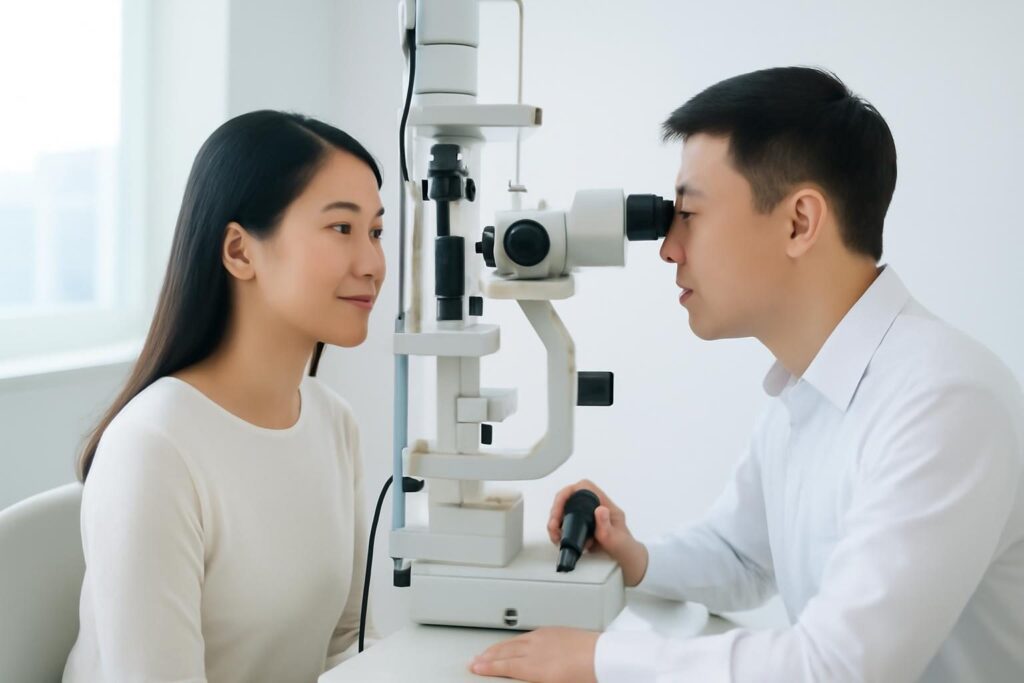
A proper pre-operative evaluation is usually completed in a single visit (often around half a day) and typically includes:
- Refraction: precise measurement of your prescription, sometimes after eye drops that relax focusing (cycloplegic refraction).
- Corneal topography and tomography: detailed maps of the corneal shape to detect irregularity or early keratoconus.
- Pachymetry: measurement of corneal thickness to confirm there is enough tissue.
- Dry-eye assessment: tear-film and ocular-surface checks.
- Dilated eye examination: inspection of the lens, optic nerve and retina to rule out cataract, glaucoma and retinal problems.
- Pupil size and general eye-health checks.
The surgeon weighs all of these together; one borderline result does not automatically rule you out, and one normal result does not automatically clear you.
What it typically costs in Singapore
As a rough guide for both eyes in 2025–2026, advertised private prices in Singapore commonly fall around S$4,500–S$5,500 for bladeless LASIK or surface laser (PRK/TransPRK), around S$5,000–S$5,500 for SMILE, and roughly S$6,900–S$9,900 for ICL depending on prescription. A separate suitability assessment fee (often around S$50–S$160) usually applies. Prices vary by clinic, technology and your prescription, so treat these as indicative and confirm directly with the provider.
Related guides
- Best LASIK Clinics in Singapore — our editorial shortlist
- LASIK & laser-eye clinics directory
- LASIK vs SMILE vs ICL: which is right for you?
- LASIK cost in Singapore (2026)
- Cataract surgery in Singapore: cost & process
Sources
- HealthHub (Singapore Ministry of Health) – LASIK and Laser Vision Correction
- National University Hospital (NUH) – Refractive Surgery (LASIK)
- Shinagawa Eye Centre Singapore – LASEK vs LASIK vs PRK vs SMILE
- Clearvision Eye Clinic & LASIK Centre – Am I Suitable for LASIK?
Part of our Eye & vision guides · Browse all health topics