
Quick answer. Cataract surgery is one of Singapore’s most common day-surgery procedures: the cloudy natural lens is removed by phacoemulsification (ultrasound) and replaced with an artificial intraocular lens (IOL), usually one eye at a time and taking around 20-40 minutes. Sticker prices vary enormously, from roughly S$800-S$2,000 per eye for subsidised treatment at a public (restructured) hospital to about S$4,000-S$12,000+ per eye in the private sector, driven mainly by the public-vs-private pathway, surgeon seniority and lens choice. Crucially, for Singapore Citizens and PRs, government subsidies plus MediSave withdrawals and MediShield Life can cut the actual out-of-pocket cost far below the headline figure – sometimes to a few hundred dollars on the subsidised public route. This is general information, not medical advice.
Cataracts are a leading cause of blurry vision in older adults, and surgery to fix them is among the most frequently performed operations in Singapore. The procedure itself is highly standardised and quick, but the cost can look confusing because it depends heavily on whether you go through the subsidised public system or a private clinic, which surgeon operates, and which type of lens you choose. This guide explains what a cataract is, how surgery works, the realistic cost ranges in 2026, and how MediSave, MediShield Life and government subsidies can dramatically reduce what you actually pay.
At a glance
| Pathway / lens | Typical cost per eye | Notes (subsidy/MediSave) |
|---|---|---|
| Public hospital, subsidised (Citizen/PR), monofocal IOL | ~S$800-S$2,000 | Means-tested subsidy; MediSave (~S$2,450/eye) and MediShield Life can cover most or all, so out-of-pocket may be a few hundred dollars or less |
| Public hospital, non-subsidised, monofocal IOL | ~S$4,200-S$5,400 | No government subsidy; MediSave and MediShield Life still claimable up to limits |
| Private clinic / hospital, monofocal IOL | ~S$7,000-S$10,000+ | Choice of senior surgeon and shorter wait; MediSave usable to limits; IP may cover more |
| Premium lens upgrade (toric / multifocal / EDOF / trifocal) | Add ~S$1,000-S$4,000+ on top | Upgrade portion generally NOT covered by subsidy, MediSave limits or insurance |
| Laser-assisted (femtosecond) surgery | Additional add-on cost | Typically an out-of-pocket upgrade, not subsidised |
What is a cataract and what are the symptoms?
A cataract is a clouding of the eye’s natural lens, which sits behind the pupil and focuses light onto the retina. It usually develops slowly with age as proteins in the lens clump together, though it can also be caused by diabetes, eye injury, long-term steroid use or certain congenital conditions.
Common symptoms include:
- Blurry, hazy or “foggy” vision that glasses no longer fully correct
- Increased glare and halos around lights, especially when driving at night
- Faded or yellowed colours
- Needing brighter light to read, or frequent changes in spectacle prescription
- Double vision in one eye
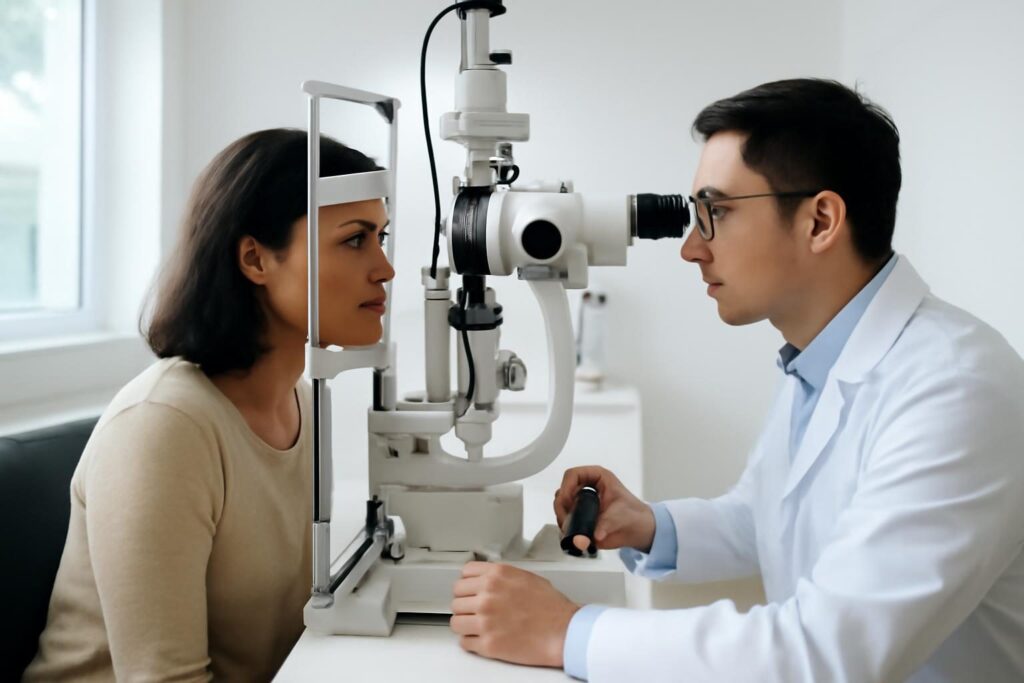
Cataracts are not an emergency in most cases, but when blurred vision starts interfering with daily activities such as reading, driving or work, surgery is usually recommended. An eye specialist (ophthalmologist) confirms the diagnosis with a slit-lamp examination and measurements to plan the procedure.
How cataract surgery works and what to expect
The standard technique in Singapore is phacoemulsification. The surgeon makes a tiny incision (often around 2–3 mm and usually self-sealing without stitches), uses ultrasound energy to break up the cloudy lens, removes the fragments, and inserts a clear artificial intraocular lens (IOL) in its place.
- Day surgery: You go home the same day. The operation itself typically takes around 20–40 minutes for a routine case.
- One eye at a time: Cataract surgery is usually priced and performed per eye, with the second eye done on a separate day if needed.
- Anaesthesia: Most procedures use local anaesthesia (eye drops or an injection around the eye) with light sedation, so you are awake but comfortable.
- Aftercare: You will use medicated eye drops for several weeks to prevent infection and inflammation, and attend follow-up reviews.
Some clinics also offer laser-assisted (femtosecond) cataract surgery, where a laser performs some steps. This adds cost and is generally an out-of-pocket upgrade rather than a subsidised option.
Public vs private pathway – and how it affects cost
The single biggest driver of cost is which pathway you use.
Public / subsidised pathway: You typically start with a polyclinic referral to a restructured hospital or the Singapore National Eye Centre (SNEC). Singapore Citizens and PRs who qualify for subsidised treatment pay the lowest rates because the government subsidises a large portion of the bill. The trade-offs are that you may not choose your specific surgeon, and waiting times for subsidised, non-urgent surgery can be long.
Private pathway: Private clinics and hospitals (and non-subsidised treatment at public hospitals) cost more but offer choice of a named senior surgeon, shorter waiting times, and more lens and technology options.
As a rough guide for 2026, typical market ranges are around S$800–S$2,000 per eye subsidised at a public hospital, roughly S$4,000–S$5,400 per eye non-subsidised at a public hospital, and around S$7,000 to over S$12,000 per eye in private clinics — before MediSave and insurance offsets. These are indicative ranges only; always ask for a written quote and financial counselling estimate.
Lens (IOL) choices and how they change the price
The artificial lens you choose has a major impact on both cost and subsidy eligibility.
- Standard monofocal IOL: Provides clear vision at a single distance (usually far), so you will likely still need reading glasses. This is the workhorse lens and is the option eligible for subsidies, MediSave and MediShield Life in the subsidised pathway.
- Toric IOL: Corrects astigmatism. Often a paid upgrade.
- Premium multifocal / extended-depth-of-focus (EDOF) / trifocal IOLs: Aim to reduce dependence on glasses across multiple distances. These add a significant out-of-pocket cost.
An important point for budgeting: premium lens upgrades are generally excluded from subsidies, MediSave limits and insurance. The subsidy and MediShield Life framework is designed around standard monofocal lenses, so choosing a premium IOL means paying the difference yourself, often adding several thousand dollars per eye.
Financing: MediSave, MediShield Life and subsidies
This is why the real out-of-pocket cost can be far lower than the sticker price for Citizens and PRs.
- Government subsidies (public hospitals): Singapore Citizens and PRs who qualify for subsidised treatment at restructured hospitals receive substantial means-tested subsidies on the bill, with Citizens generally receiving higher subsidies than PRs.
- MediSave: You can withdraw from your (or an immediate family member’s) MediSave to pay the bill, subject to MOH withdrawal limits. For cataract day surgery, commonly cited limits allow withdrawal of roughly S$2,450 per eye (combining the surgical limit under the Table of Surgical Procedures with the day-surgery ward limit). Always confirm the current figure, as MOH updates limits periodically.
- MediShield Life: This national health insurance helps cover larger, subsidised bills and is structured around subsidised public-hospital and day-surgery costs, with a fixed claim limit for the cataract procedure (after the deductible and co-insurance). It pays much less toward private bills.
- Integrated Shield Plans (IPs): Private insurance riders can cover more of a private or higher-class bill, but most exclude premium lens upgrades and laser add-ons.
In practice, a subsidised Citizen using MediSave and MediShield Life may pay relatively little out-of-pocket, while a private patient choosing a senior surgeon and a premium lens will pay the most. Use the hospital’s financial counsellors and official MOH/CPF tools for an accurate personal estimate.
Recovery and risks
Recovery is usually fast. Many people notice clearer vision within a few days, with vision stabilising over about 4–6 weeks as the eye fully heals. You will typically be advised to use prescribed eye drops on schedule, avoid rubbing the eye and heavy lifting for a period, keep water and dust out of the eye, wear a protective shield as instructed, and attend all follow-ups.
Cataract surgery has a very high success rate, but no surgery is risk-free. Possible complications include infection, inflammation, swelling at the back of the eye (macular oedema), raised eye pressure, posterior capsule rupture during surgery, or clouding of the lens capsule months to years later (posterior capsule opacification, which is easily treated with a quick laser procedure). Discuss your individual risk profile with your ophthalmologist, particularly if you have diabetes, glaucoma or other eye conditions.
Related guides
- Best Eye Clinics in Singapore — our editorial shortlist
- eye clinics directory
- LASIK vs SMILE vs ICL: which is right for you?
- LASIK cost in Singapore (2026)
- Am I suitable for LASIK?
Sources
- Ministry of Health Singapore – MediSave Inpatient/Day Surgery Care (withdrawal limits)
- Ministry of Health Singapore – MediShield Life Benefits
- CPF Board – What MediShield Life Covers You For
- SingHealth – Cataract: Diagnosis, Procedure & Risks
- Health365 – Cataract Surgery Cost Singapore: Public vs Private
Related conditions & guides
Related conditions and guides you may find useful:
- Diabetic Retinopathy in Singapore
- Dry Eye Syndrome in Singapore
- Eye Floaters and Flashes in Singapore
- Glaucoma in Singapore
- Age-Related Macular Degeneration (AMD) in Singapore
- Myopia Control in Children
- Using MediSave for Medical Treatment in Singapore
Part of our Eye & vision guides · Browse all health topics