
Quick answer. Medical imaging covers ultrasound, X-ray, CT and MRI – each suited to different problems. Ultrasound and MRI use no ionising radiation; X-ray and CT do. Most scans need a doctor’s referral, and costs are far lower at subsidised public centres than at private radiology clinics.
Not sure which gp and family clinic you need?
Message our care team on WhatsApp. Tell us what’s going on and we’ll help you find the right gp and family clinic — free, with no obligation.
Chat with our care team on WhatsAppNot sure who to see? Find the right specialist →
In a medical emergency, or for severe or sudden symptoms such as breathing difficulty, chest pain, fainting or stroke signs, call 995 immediately.
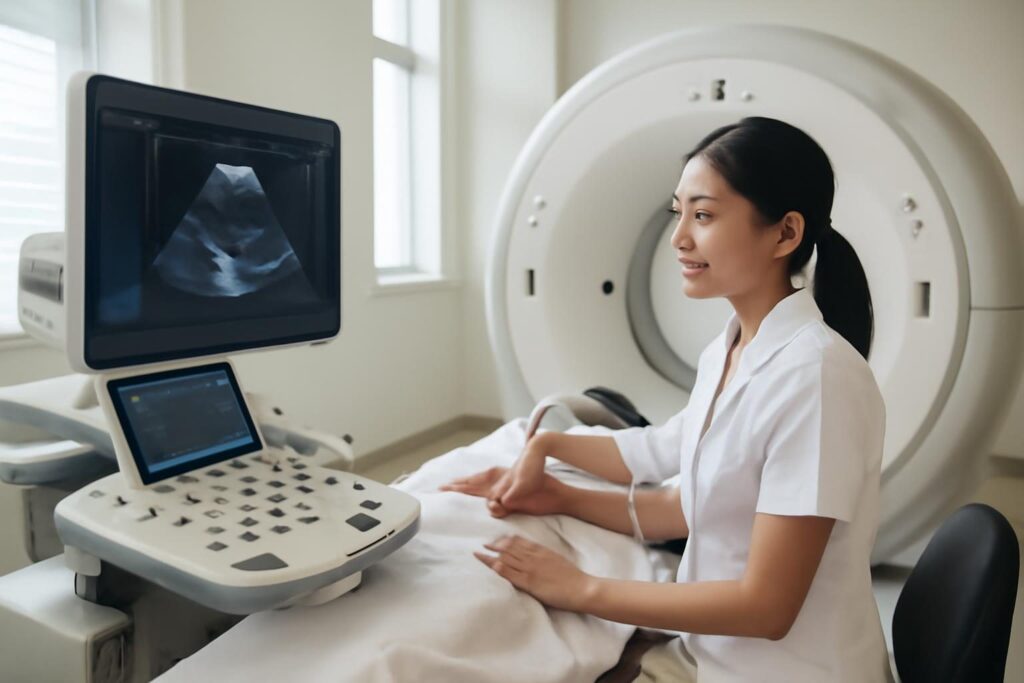
If your doctor has asked you to get a scan, it helps to know what each type of medical imaging actually does. In Singapore, most diagnostic imaging is done in one of four ways – ultrasound, X-ray, CT (computed tomography) and MRI (magnetic resonance imaging) – plus focused bedside scanning known as point-of-care ultrasound. They are not interchangeable: the right choice depends on what part of the body is being looked at, whether soft tissue or bone is the concern, and whether avoiding radiation matters (for example, in pregnancy).
This guide is an overview of how the main scans compare, what they cost in the public versus private sector, and how referrals and preparation work here. For detail on each one, see our dedicated guides to ultrasound scans, point-of-care ultrasound (POCUS), X-rays, CT scans and MRI scans. Best Doctors Singapore is an independent directory and guide – we are not a radiology provider, and this page is general information, not medical advice.
At a glance
| Scan type | Ionising radiation? | Best suited for |
|---|---|---|
| Ultrasound | No | Soft tissue in real time – abdomen, pelvis, pregnancy, thyroid, blood flow (Doppler) |
| X-ray | Yes (low dose) | Bones and fractures, chest and lungs, dental |
| CT scan | Yes (higher dose) | Detailed cross-sections fast – trauma, stroke, chest, abdomen, cancer staging |
| MRI scan | No | Soft tissue detail – brain and spine, joints and ligaments, prostate, some cancers |
| POCUS (bedside) | No | Quick focused questions answered by the treating doctor at the bedside |
The main types of medical imaging
Each modality works on a different physical principle, which is why each is good at different things:
- Ultrasound uses high-frequency sound waves and shows soft tissue and blood flow in real time. It uses no radiation, which is why it is the workhorse of pregnancy scans and a first choice for the abdomen, pelvis, thyroid, breast and blood vessels.
- X-ray uses a small dose of ionising radiation and is best at showing bone. It is quick and inexpensive – the usual first scan for a suspected fracture or a chest problem.
- CT takes many X-ray images and reconstructs them into detailed cross-sections. It is fast and excellent in emergencies (major trauma, suspected stroke, severe abdominal pain) and for staging cancer, at the cost of a higher radiation dose than a plain X-ray.
- MRI uses a strong magnet and radio waves – no radiation – and gives the most detailed pictures of soft tissue, such as the brain and spinal cord, joints and ligaments, and the prostate.
- Point-of-care ultrasound (POCUS) is a focused ultrasound the treating doctor performs at the bedside to answer one specific question quickly – it complements, rather than replaces, a formal scan.
Which scan for which problem
You will not usually choose the scan yourself – the referring doctor picks the modality that best answers the clinical question. As a rough guide to how decisions are made:
- Bone injury or fracture: X-ray first; CT or MRI if more detail is needed.
- Abdominal pain, gallstones, liver, kidneys: often ultrasound first, then CT if needed.
- Pregnancy: ultrasound only (no radiation).
- Brain, spine, nerves: MRI for detail; CT when speed matters, such as a suspected stroke or head injury.
- Joints, ligaments and sports injuries: MRI is usually the most informative.
- Lumps in the thyroid, breast, or scrotum: ultrasound is typically the first step.
- Blood vessels and clots: Doppler ultrasound, CT angiogram or MRI depending on the site.
If a scan finds something that needs a closer look, a second modality is often used to confirm it – the scans work together rather than competing.
Radiation and safety: what is and is not safe
The most common patient worry is radiation. Here is the honest picture:
- No ionising radiation: ultrasound and MRI. These are preferred where radiation should be avoided, including in pregnancy and for repeated monitoring.
- Uses ionising radiation: X-ray (a low dose) and CT (a higher dose). The dose from a single X-ray is small, and doctors weigh the benefit of the information against the exposure before ordering any scan involving radiation.
Other safety points to know: MRI uses a very strong magnet, so you must declare any pacemaker, cochlear implant, metal fragments or certain implants, and the scan can feel enclosed and noisy. Contrast dye (used in some CT and MRI scans) is generally safe but the centre will ask about allergies and kidney function. If you are or might be pregnant, tell the radiographer before any scan.
Referrals, preparation and getting your results
In Singapore, most diagnostic scans require a doctor’s referral – from a GP, polyclinic or specialist – rather than a walk-in request. The referral tells the radiology centre exactly what to look for.
Preparation depends on the scan: an abdominal ultrasound usually needs a few hours of fasting; a pelvic or pregnancy ultrasound may need a full bladder; a CT or MRI with contrast may need fasting and a kidney-function blood test. The centre will give you specific instructions when you book. Plain X-rays and most ultrasounds are quick (minutes); CT is fast; MRI takes longer (often 30 to 60 minutes). Results are read and reported by a radiologist and sent back to your referring doctor, who explains what they mean for you – urgent findings are flagged quickly, while routine reports typically take a few working days.
Cost of scans in Singapore: public versus private
Cost depends heavily on where you go and which scan you need. In broad terms, subsidised public imaging (polyclinic referrals and restructured hospitals) is considerably cheaper for eligible patients than private radiology centres, which offer shorter waits and more appointment choice.
As a rough, order-of-magnitude guide to private self-pay fees – these are typical market ranges that vary by centre, body part and whether contrast is used, not quotes – a plain X-ray is usually the least expensive, an ultrasound moderate, and CT and especially MRI the most expensive. Each dedicated guide covers its own range in more detail. Two things to plan around: MediSave generally cannot be used for routine outpatient diagnostic scans (it is mainly for approved treatments, day surgery and hospitalisation), and MediShield Life is designed for inpatient care – so screening or outpatient scans are often out of pocket. Always confirm the current fee and any subsidy or insurance coverage with the provider before booking.
Where to get a scan and which doctor to see
If you have symptoms but no referral yet, a sensible first stop is a GP, who can assess you, arrange the appropriate first-line scan and refer you onward if needed. Browse our directory of GP and family clinics in Singapore to start.
Where a specialist is already involved, they will usually order the scan themselves. Depending on your problem, that might be a orthopaedic surgeon (bones and joints), a gastroenterologist (abdomen and gut), a gynaecologist (pelvic and pregnancy scans), a neurologist (brain and nerves), a vascular surgeon (blood vessels) or an oncologist (cancer staging and monitoring). The radiologist who performs and reports the scan works behind the scenes with whichever doctor referred you.