
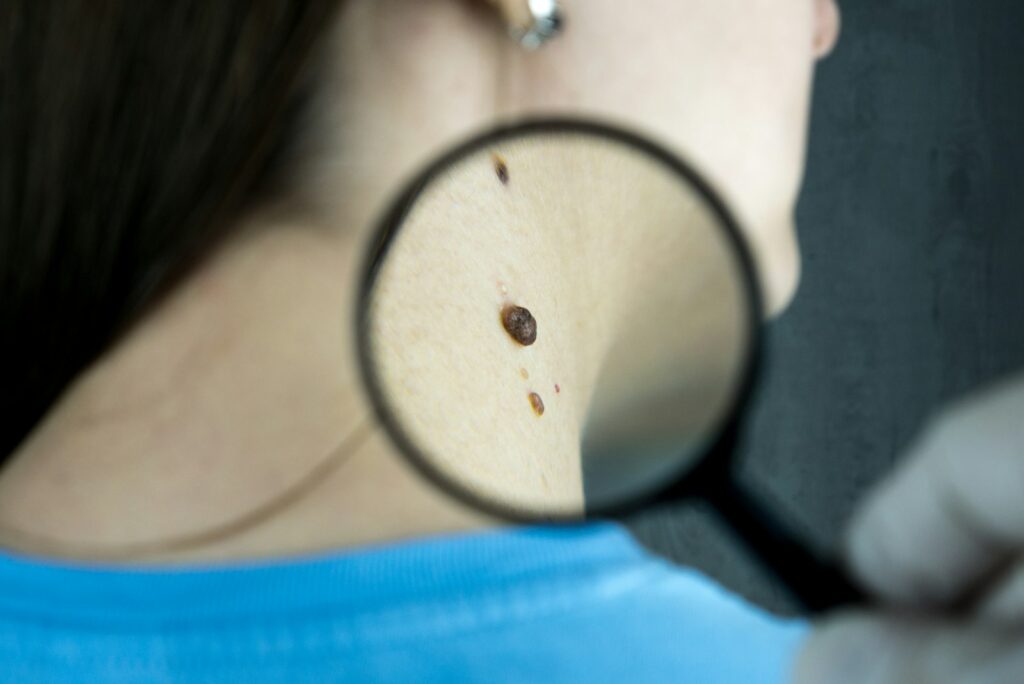
Dealing with a stubborn rash, acne or a changing mole?
Message our care team on WhatsApp. Tell us what’s going on and we’ll help you find the right best dermatologist — free, with no obligation.
Chat with our care team on WhatsAppNot sure who to see? Find the right specialist →
In a medical emergency, or for severe or sudden symptoms such as breathing difficulty, chest pain, fainting or stroke signs, call 995 immediately.
Coming to Singapore from overseas for treatment? See our guide for international patients — costs, visas, travel and language support — or chat with our care team on WhatsApp.
At a glance
- The three main skin cancers are basal cell carcinoma, squamous cell carcinoma, and the less common but more serious melanoma.
- Most are linked to ultraviolet (UV) exposure from the sun, which is intense and year-round in Singapore.
- Early detection matters — the great majority of skin cancers are highly treatable when found and treated early.
- Any new, changing or non-healing skin spot is worth having checked, even though most turn out to be harmless.
- Skin cancer can occur in all skin tones, and in Asian skin it sometimes appears on the palms, soles or under nails.
Skin cancer happens when skin cells grow abnormally, most often after cumulative UV damage over many years. It is one of the more common cancers worldwide, and Singapore’s tropical sun means UV exposure is a genuine everyday factor. The reassuring news is that skin cancer is usually visible on the surface, which makes it one of the easier cancers to catch early — and early skin cancers are among the most curable of all cancers. This guide explains the main types, the warning signs to watch for, how a diagnosis is made, and the treatments and prevention steps a doctor or dermatologist may discuss.
The main types
Basal cell carcinoma (BCC) is the commonest type and the least aggressive. It usually appears as a pearly or waxy bump, a flat scaly patch, or a sore that does not heal, most often on sun-exposed areas such as the face, ears, neck or scalp. BCC tends to grow slowly and very rarely spreads to other parts of the body, but it can enlarge and damage nearby tissue if left untreated, so it should still be removed.
Squamous cell carcinoma (SCC) is the second most common type. It often looks like a firm red lump, a scaly or crusted patch, or a sore that bleeds and does not heal. SCC also favours sun-exposed skin, including the backs of the hands, lower lip and ears. It grows faster than BCC and, if neglected, has a greater potential to spread, so timely treatment is important.
Melanoma is less common than BCC and SCC, but it is the most serious because it is more likely to spread if not caught early. It usually arises in a new mole or an existing mole that changes, and it can appear anywhere on the body. In people with fairer skin it is often on sun-exposed areas, but in Asian and darker skin tones melanoma more often develops in less sun-exposed sites — the palms, soles of the feet, or under a fingernail or toenail (a type sometimes called acral melanoma). Because of this pattern, it is worth checking these areas too, not just the face and arms.
Warning signs — the ABCDE of melanoma and other changes
The ABCDE rule is a simple, widely used guide for spotting a mole that may be a melanoma:
- A — Asymmetry: one half of the mole does not match the other.
- B — Border: edges are irregular, ragged, notched or blurred rather than smooth.
- C — Colour: uneven colour, with shades of brown, black, and sometimes red, white or blue within the same spot.
- D — Diameter: larger than about 6mm (roughly the size of a pencil eraser), or a spot that is enlarging.
- E — Evolving: any change in size, shape, colour, or a mole that starts to itch, bleed or crust.
Alongside the ABCDE signs, other changes deserve attention: a sore that does not heal within a few weeks, or that bleeds and crusts repeatedly; a new lump, or a scaly or rough patch that persists and does not settle; and a new dark streak or band appearing under a fingernail or toenail. The “ugly duckling” sign is also useful — a mole that simply looks different from the others on your body is worth showing to a doctor. Most spots are harmless, but changing ones should always be checked.
Symptoms — what to look for
Skin cancers can look quite different from one another, which is why any of the following is a reason to get a spot assessed: a new growth or unusual mark on the skin; a mole that changes in size, shape or colour; a sore or ulcer that does not heal; a pearly, waxy or shiny bump; a red, scaly or crusted patch; a spot that bleeds, itches or feels tender; or a dark line under a nail. Skin cancer is usually not painful in its early stages, so relying on how a spot feels can be misleading — its appearance and any change over time are more telling. If you are unsure, it is always reasonable to have a doctor or dermatologist take a look.
Causes and who is at risk
The single biggest factor is ultraviolet (UV) radiation, mainly from the sun and also from tanning beds. UV damages the DNA in skin cells, and this damage builds up over a lifetime. Both a history of intense, blistering sunburns and long-term cumulative exposure contribute, which is why Singapore’s strong, year-round sunshine is relevant even without deliberate tanning.
Other factors that raise risk include:
- Fair skin that burns easily, freckles, or has light-coloured eyes and hair — though skin cancer occurs in all skin tones.
- Having many moles, or atypical (unusual-looking) moles.
- A personal or family history of skin cancer or melanoma.
- Older age, reflecting a lifetime of accumulated sun exposure — though melanoma can also affect younger adults.
- A weakened immune system, for example after an organ transplant or with certain medical conditions or medicines.
- Substantial outdoor sun exposure, whether through work or recreation, and previous radiotherapy.
Importantly, having risk factors does not mean you will develop skin cancer, and people with none of them can still be affected. Because skin cancer occurs in all skin tones and sometimes in areas that see little sun, everyone benefits from being aware of changes to their skin.
How it is diagnosed
Diagnosis usually begins with a careful skin examination. A doctor or dermatologist looks at the spot in question and often checks the rest of the skin, since people who have one skin cancer are at higher risk of another. To see a lesion in more detail, the doctor may use a dermoscope — a handheld device with magnification and light that reveals patterns and structures not visible to the naked eye, helping to tell harmless spots from suspicious ones.
If a lesion looks suspicious, the only way to confirm the diagnosis is a biopsy, in which a small sample of the spot (or the whole spot) is removed under local anaesthetic and examined under a microscope. The biopsy confirms whether cancer is present, and if so, which type and how deep it is — information that guides treatment. In Singapore, an initial assessment can start with a GP or polyclinic, who may refer you to a dermatologist, the National Skin Centre, or a specialist for further evaluation. If melanoma is confirmed, further tests may occasionally be arranged to check whether it has spread.
Treatment
Treatment depends on the type of skin cancer, its size, location and stage, and your general health. Surgery to remove the cancer (excision) is the mainstay for most skin cancers, and for early BCC, SCC and melanoma this is often all that is needed. The surgeon removes the cancer along with a margin of normal-looking skin to help ensure it is completely taken out. For certain facial or recurrent skin cancers, a specialised technique that checks the margins during surgery may be used to remove the cancer while sparing healthy tissue.
Other options are suitable for selected cases, and a doctor will advise what fits your situation:
- Topical treatments (prescription creams) may be used for some very superficial, early non-melanoma cancers or pre-cancerous patches.
- Cryotherapy (freezing) can treat some small, superficial lesions and pre-cancers.
- Radiotherapy may be an option when surgery is not suitable, or as an additional treatment in certain cases.
For advanced melanoma, or skin cancer that has spread, care is provided by a specialist multidisciplinary team and may involve additional treatments beyond surgery, planned according to the individual situation. Modern treatments have improved outcomes for advanced disease considerably. Overall, when skin cancer is found and treated early, the outlook is generally very good — which is the strongest reason to have new or changing spots checked promptly rather than waiting.
Prevention and self-checks
Reducing UV exposure is the most effective way to lower risk, and it is very doable in Singapore’s climate:
- Seek shade, especially in the middle of the day when the sun is strongest.
- Wear protective clothing — a wide-brimmed hat, sunglasses, and covering clothing when out in the sun for long periods.
- Use sunscreen with broad-spectrum protection on exposed skin, reapplying regularly, particularly with sweating, swimming or extended time outdoors.
- Avoid deliberate tanning and tanning beds.
Just as important is getting to know your own skin. A regular self-examination — for example once a month, in good light and using a mirror or a partner’s help for hard-to-see areas such as the back, scalp, soles and between the toes — makes it easier to notice something new or changing. Take note of any spot that is new, growing, or meets the ABCDE signs. If you have many moles, a strong family history, or have had skin cancer before, a doctor may suggest periodic professional skin checks. You can arrange a professional skin check if you would like a spot assessed or your skin reviewed.
When to see a doctor
See a doctor or dermatologist promptly if you notice any of the following, so it can be assessed and, if needed, treated early:
- A new mole, or a mole that is changing — Asymmetrical, with an irregular Border, uneven Colour, an enlarging Diameter, or otherwise Evolving (the ABCDE signs).
- A sore that does not heal, or that bleeds and crusts repeatedly.
- A new lump, or a scaly or rough patch that persists over weeks.
- A new dark streak or band under a fingernail or toenail.
- Any spot that itches, bleeds, or simply looks different from your other moles.
Most of these turn out to be harmless, and getting them checked brings peace of mind. Skin cancer itself is not a medical emergency, so there is no need to call 995 for a skin spot — but do make an appointment rather than waiting, since early assessment gives the best outcomes.
Common questions
How can I tell if a mole is cancerous?
Use the ABCDE rule — Asymmetry, irregular Border, uneven Colour, enlarging Diameter, and Evolving change — and watch for a mole that itches, bleeds, or looks different from your others. These features do not confirm cancer, but they mean the spot should be checked. Only a doctor’s examination and, if needed, a biopsy can tell for certain.
Is skin cancer common in Asian skin?
It is less common than in fair skin, but it does occur, and it can be more easily missed. In Asian and darker skin tones, melanoma more often appears on the palms, soles or under the nails rather than on sun-exposed areas, so it is worth checking these sites too.
Is skin cancer curable?
The great majority of skin cancers are highly curable when found and treated early, which is why prompt assessment of new or changing spots is so valuable. Even more advanced disease can be treated by a specialist team, with treatments that have improved considerably in recent years.
Does a mole that is removed mean it was cancer?
Not necessarily. Doctors sometimes remove a mole simply to examine it closely or because it is changing, and many turn out to be harmless. Removal and biopsy is a way of finding out for certain, not a sign that cancer has been confirmed.
Do I still need sun protection in Singapore if I am not trying to tan?
Yes. UV levels are high year-round in Singapore, and everyday incidental exposure adds up over time. Shade, protective clothing and sunscreen on exposed skin all help reduce cumulative UV damage.
Related guides
- Mole removal & skin cancer screening
- Actinic keratosis
- Skin lump under the skin
- Best dermatologists in Singapore
Sources
- Dermatological Society of Singapore — skin cancer.
- National Skin Centre — skin cancer.
- National Cancer Centre Singapore — skin cancer.
- Singapore Cancer Society — skin cancer.
- HealthHub (Singapore) — skin cancer and sun protection.
This article is for general information only and does not replace a consultation with a qualified doctor. Please seek personalised medical advice for your situation.