
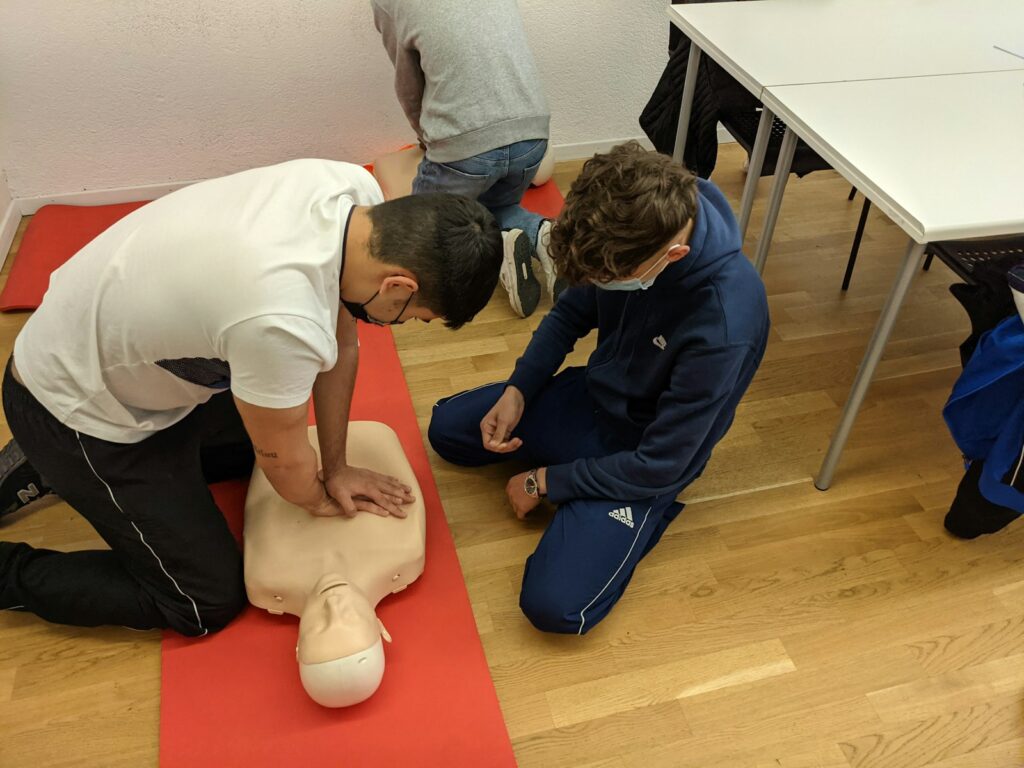
Quick answer. If someone collapses and is unresponsive and not breathing normally, treat it as cardiac arrest and act within seconds. Call 995 on speakerphone and activate the myResponder app so nearby responders and the nearest AED can be found. Then start hands-only (compression-only) CPR: push hard and fast in the centre of the chest at 100–120 compressions a minute, about 4–6 cm deep, letting the chest fully recoil each time. The 995 call-taker will coach you – don’t hang up. Keep going until an AED arrives, the person wakes, or paramedics take over.
Cardiac arrest is when the heart suddenly stops pumping. Every minute without CPR and defibrillation lowers the chance of survival, so a bystander who acts immediately – even without training – genuinely saves lives. Hands-only CPR is what Singapore’s guidelines recommend for untrained rescuers.
Step by step
- Check the scene is safe for you and the casualty.
- Check for a response – tap both shoulders and ask loudly, “Are you okay?”
- Shout for help and get bystanders to assist.
- Check breathing – look for the chest rising and falling. No breathing, or only abnormal gasping, means cardiac arrest.
- Call 995 (put the phone on speaker) and activate myResponder to alert nearby responders and find the nearest AED.
- Let the 995 call-taker guide you – this is dispatcher-assisted CPR; follow their instructions and stay on the line.
- Position your hands – heel of one hand on the centre of the chest (lower half of the breastbone), other hand on top, fingers interlocked, shoulders directly above, elbows locked straight.
- Push hard and fast – depth about 4–6 cm, rate 100–120 a minute (roughly two per second).
- Let the chest fully recoil after each compression, and keep interruptions to a minimum.
- Send someone for the nearest AED and use it the moment it arrives; resume compressions immediately after any shock.
- Continue until the AED is analysing, the person wakes with normal breathing, or SCDF paramedics take over. Swap rescuers about every 2 minutes if others can help.
Hands-only or with rescue breaths?
For untrained bystanders, compression-only CPR is the priority – don’t stop to give breaths. Rescue breaths (a 30 compressions to 2 breaths cycle) are for rescuers who are trained, willing and able, and should never delay good chest compressions. For a child or infant, compress about one-third of the chest’s depth; because children more often arrest from a breathing problem, trained rescuers include rescue breaths – but if you are untrained, compression-only CPR is still far better than doing nothing.
Do and don’t
Do: call 995 first and put it on speaker; activate myResponder; push hard and fast (centre of chest, 100–120/min, 4–6 cm); allow full recoil; follow the dispatcher’s coaching; send for an AED.
Don’t: delay compressions to check a pulse; stop except to let the AED analyse or shock; be afraid of causing a cracked rib (survivable – untreated cardiac arrest is not); give up early; or withhold help because you’re untrained – hands-only CPR needs no certification to attempt.
Get trained
DARE (Dispatcher-Assisted first REsponder) is a free, roughly 45-minute community course teaching compression-only CPR and AED use. For fuller certification, take an SRFAC-accredited “Save-A-Life” CPR+AED course through the Singapore Heart Foundation, Singapore Red Cross or St John Singapore. See our guide to using an AED.
Related first-aid & emergency guides
- How to use an AED (defibrillator)
- Choking first aid: adult, child & infant
- How to stop severe bleeding
- Burns & scalds first aid
- Seizure first aid
- The recovery position & the unconscious casualty
- Heat exhaustion & heat stroke first aid
- Head injury: when to worry
- Anaphylaxis & using an adrenaline auto-injector
Related condition guides
- Stroke warning signs (FAST)
- Heart attack warning signs
- Anaphylaxis & severe allergy
- Epilepsy & seizures
Sources
- Singapore Resuscitation and First Aid Council (SRFAC) — Singapore Basic Cardiac Life Support & AED Guidelines 2021 (rate 100–120/min, depth 4–6 cm, compression-only CPR for lay rescuers, dispatcher-assisted CPR).
- Singapore Heart Foundation — How to perform CPR+AED for adults (bystander sequence: 995, myResponder, hand position, depth, rate).
- SRFAC — Singapore Paediatric Resuscitation Guidelines 2021 (child/infant compression depth ~ one-third of chest).
- DARE (Dispatcher-Assisted first REsponder) and SCDF myResponder — free community CPR+AED programme and responder/AED locator.