
Daily feeding tube care becomes a simple routine once your nutrition nurse has shown you how. The aims are to keep the skin around the tube healthy, keep the tube unblocked, and keep the tube secure and correctly positioned. This guide describes the principles and what to watch for — but the hands-on technique, and the exact water amounts and schedules, should always come from your own team, who tailor them to your tube.
Ongoing tummy pain, reflux or a change in bowel habits?
Message our care team on WhatsApp. Tell us what’s going on and we’ll help you find the right gastroenterologist — free, with no obligation.
Chat with our care team on WhatsAppNot sure who to see? Find the right specialist →
In a medical emergency, or for severe or sudden symptoms such as breathing difficulty, chest pain, fainting or stroke signs, call 995 immediately.
This is general information and does not replace the training your nutrition nurse gives you. Contact your team urgently if the tube falls out (the opening can begin to close within hours), for signs of site infection, or if the tube blocks and will not clear. Call 995 for severe tummy pain or breathing difficulty.
Keeping the stoma site clean
The skin where the tube enters — the stoma site — is cleaned daily around the tube and under the external fixation with water, then dried well, to reduce soreness and infection. Watch the skin each day for redness, swelling, discharge, or over-granulation (a moist, red overgrowth of tissue that can bleed). Once the site is healed, your team may allow mild soap and water. A clean, dry, well-cared-for site is the foundation of trouble-free tube feeding, so this daily check is time well spent. Report skin changes to your nurse rather than waiting, since a sore or leaking site is easier to settle when it is caught early.
Flushing — the most important habit
Flushing the tube with water is the single most important thing you do to keep it working. Flush before and after every feed, before and after medicines, and at least once a day when the tube is not in use — using the amount and type of water your team specifies. Faithful flushing is what prevents blockages, which are common but largely avoidable. If a tube does block, gentle warm water is the standard first measure; never use fizzy drinks or fruit juices to try to clear it.
Advancing and rotating (preventing buried bumper)
For a PEG with an internal bumper, once the tract has healed the team teaches you to gently advance and rotate the tube on a routine — easing the external plate back, pushing the tube in a little and turning it, then returning it. This prevents buried bumper syndrome, where the internal disc becomes overgrown by the stomach lining. The start date and frequency are set by your team. This does not apply during the early healing period, and jejunal extensions (PEG-J) are generally not rotated.
Balloon and button checks
Balloon-retained tubes and low-profile buttons have no firm bumper to rotate. Instead, the water in the retaining balloon is checked and refreshed on the schedule your team sets — do not change the balloon volume yourself. Buttons need an extension set attached for feeding and flushing, then removed and cleaned as taught. Whatever your device, keeping to the specific check routine your team gives keeps it secure.
Securing the tube and mouth care
Keep the tube secured — looped or lightly taped as trained — so it is not snagged on clothing or pulled. And keep up mouth care even if you eat little or nothing by mouth: the mouth gets dry and can become sore or infected when it is not used, so brush teeth gently, keep lips and mouth moist, and use any prescribed dry-mouth products. Good oral hygiene also lowers the risk of chest infection.
Hand hygiene and what not to do
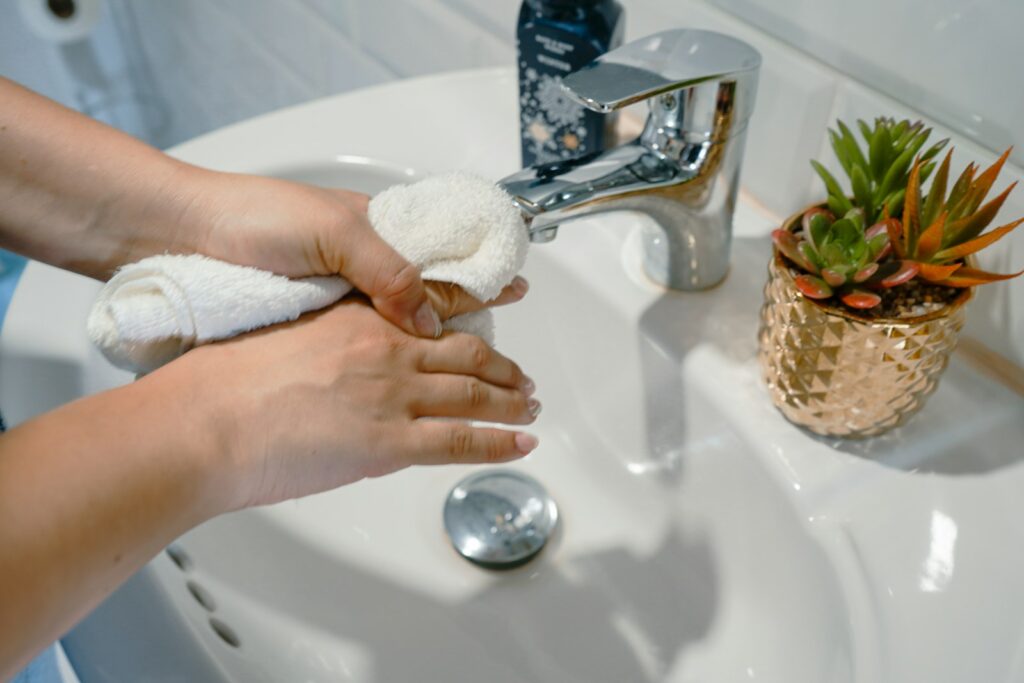
Wash your hands with soap and water before handling the tube, the site, or preparing feed and medicines. A few things to avoid: do not let the tube block (flush faithfully); do not pull or tug on the tube; do not use fizzy drinks, pineapple or cranberry juice to unblock it (warm water is standard); and do not ignore leakage around the site or an external fixation that has become too loose or too tight — report these. A fixation left too tight can press on the skin and cause soreness, while one too loose lets the tube move and the site leak, so the correct, comfortable position is something your nurse sets and checks.
When to call your team or 995
As a rule of thumb, call your nutrition nurse or dietitian for a blocked tube that will not clear with gentle warm water, spreading redness or discharge at the site, over-granulation, persistent leakage, or a tube that has become hard to rotate or advance (a possible buried bumper). Treat as urgent — team or A&E — if the tube falls out, as the opening can begin to close within hours. Call 995 for severe tummy pain, a hard swollen abdomen, heavy bleeding, or breathing difficulty. In Singapore, your hospital nutrition team is your first contact for everyday problems.
Related feeding tube topics
- Living with a feeding tube
- Types of feeding tubes explained
- PEG tube: what to expect
- Tube feeding at home
- Giving medicines through a feeding tube
- Managing feeding tube problems
- Eating, swallowing & mouth care
- Emotional wellbeing & daily life
- Feeding tube removal
- Gastroenterologists in Singapore
- Dietitians in Singapore
Sources
- Kent Community Health NHS — Care of a PEG feeding tube: kentcht.nhs.uk
- North Tees and Hartlepool NHS — PEG discharge advice: nth.nhs.uk
- BAPEN — Enteral Nutrition: bapen.org.uk
- Cambridge University Hospitals NHS — Low-profile balloon gastrostomy tubes: cuh.nhs.uk